


“Volunteering for the environment means I am taking care of myself because I am the environment.”
By
Andy (Kwaku) Kusi-Appiah
Introduction:
This article launches the Environment column at Black Ottawa Scene (BOS), a space dedicated to honest, accessible conversations about environmental justice, community care, and sustainability as they show up in Black lives here in Ottawa. The column will explore environmental issues through a Black lens, local, lived, and practical, highlighting how everyday actions (like volunteering) are deeply connected to environmental justice, health, and collective well-being.
We begin from a simple but often overlooked truth: the environment is not something ‘out there.’ It is us; our bodies, our neighbourhoods, our community spaces, and the conditions that shape our everyday health and dignity. Long before sustainability became a buzzword, Black people were maintaining community spaces, supporting cultural and spiritual institutions, and filling the gaps left by under-resourced systems.
For Black communities in Ottawa, environmental care often begins with showing up for one another, cleaning shared spaces, supporting food programs, maintaining places of worship, and protecting the environments where we gather, heal, and organize. Choosing volunteering as the starting point affirms that environmental action does not require expertise, wealth, or institutional power. It begins with care, with presence, and with the understanding that when we take care of our environment, we are also taking care of ourselves.
Volunteering, a spiritual act:
Volunteerism is the intentional offering of one’s time, skills, and care for the benefit of others and the community, freely given, without coercion, and without expectation of financial reward. Not all labour is voluntary. Work done under pressure, threat, or economic desperation does not carry the same moral meaning as service chosen freely. The moment service is coerced; it ceases to be volunteerism. True volunteering arises from conscience, compassion, and a recognition of shared humanity. It is noble not because it is self-sacrificial, but because it is relational.
Volunteerism is not a luxury; it is a social and environmental necessity. It recognizes that our well-being is tied to the well-being of others. It affirms that a healthy society cannot survive on transactions alone; it requires trust, care, and reciprocity. Care for community, for one another, and even for our non-human cousins, is among the most spiritual acts we humans can perform. This understanding resonates deeply with Black traditions of mutual aid and collective care.
Furthermore, volunteering is not an act of excess generosity; it is an expression of collective responsibility. In this sense, volunteerism is not a luxury, it is a social and environmental necessity.
For example, Canada (Turtle Island), is held together by more than policy and institutions. It is held together by people who give their time freely to take care of the mundane things we all take for granted. Long before social services were accessible, humans relied on one another, sharing food, shelter, knowledge, and labour. That legacy continues today, often quietly, often without recognition, but always with profound impact. Volunteering for the environment means taking care of oneself because we are the environment. This is not metaphor. It is reality. We humans are not separate from the land, the air, or the community around us.

Volunteers maintain public spaces, prepare meals, shovel snow, and check in on neighbours. Former Ottawa mayor Hon. Bob Chiarelli once observed and remarked that : “This City would grind to a complete halt if volunteers went on strike for a day.” That statement rings especially true in Black and racialized communities, where mutual aid has long been a response to exclusion and underinvestment.
Volunteerism and Environmentalism:
Environmentalism is often framed as distant or technical, climate targets, policies, international conferences. But for many of us, the environment shows up in much more intimate ways: in the air we breathe, the spaces we gather in, and the systems that support our health and dignity.
When we volunteer, we reduce pressure on strained social and environmental systems. When we share resources, we reduce waste. When we care for shared spaces, we strengthen our relationship to place.
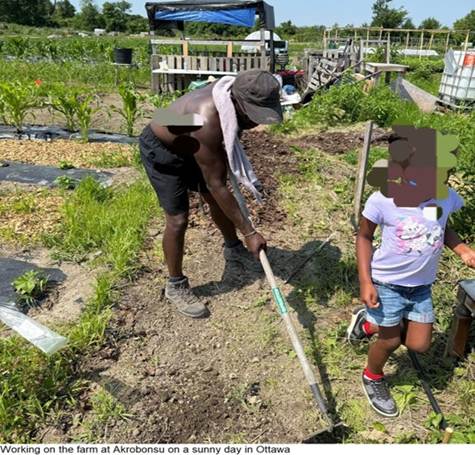
As President and CEO of Environmental Stewardship Solutions (ESS), my team and I focus on helping individuals and communities find harmony with the environment through education, outreach, and practical support.
Our work includes environmental consulting, sustainability education, and community-based services such as driving patients to medical appointments. These efforts remind us that sustainability is not abstract, it is relational. Environmental stewardship begins with how we treat one another. “I am, because we are.” is an African philosophy known as Ubuntu, which roughly translates to ‘humanity towards others’ or ‘community’ in the Zulu language.
Ubuntu promotes a set of values that prioritize community, mutual support, respect, empathy, and forgiveness. It encourages individuals to prioritize the well-being of the community over their own interests, recognizing that individual success is tied to the success of others. At its core, Ubuntu emphasizes the interconnectedness and interdependence of all human beings (and our non-human cousins), recognizing that a person’s identity and humanity are inextricably linked to the community and the natural world.
This philosophy has been an important part of African cultures for centuries, but it gained international recognition in the 20th century through the work of several prominent proponents. Desmond Tutu, former Archbishop of Cape Town, South Africa, and Nobel Peace Prize winner, has written extensively on Ubuntu and its relevance to modern society (Battle, 2009; Shutte, 1993). Similarly, Nelson Mandela’s leadership during South Africa’s democratic transition is widely interpreted by scholars as an embodiment of Ubuntu, particularly through his emphasis on forgiveness, reconciliation, and communal restoration following apartheid (Metz, 2011; Gade, 2011). Philosophically, Mogobe Ramose, has played a foundational role in the systematic development of Ubuntu, presenting it as both an ontological and ethical framework central to African philosophy (Ramose, 2001; Murove, 2009).

As globalization brings people and cultures together, Ubuntu’s emphasis on community, mutual support, and respect becomes increasingly relevant. Its focus on dignity, empathy, and forgiveness offers a powerful framework for addressing social injustices and promoting reconciliation. In addition, Ubuntu’s recognition of the interconnectedness of all living beings encourages a holistic approach to environmental sustainability. In a world where mental health is a growing concern, Ubuntu’s emphasis on community and mutual support offers a valuable perspective on well-being.
The challenges we face are real. Climate change, environmental racism, and social inequality are already shaping our lives. But despair is not a strategy. Hope grounded in action is how communities survive.
Hope lives in volunteerism.
Hope lives in shared responsibility.
Hope lives in the everyday acts of care we extend to one another.
The environment is not out there; the environment is us.
You are the environment!
Works Cited:
Battle, Michael. (2009). Ubuntu: A Model for Global Reconciliation. International Journal of Public Theology, 3(3), 263–280. DOI: https://doi.org/10.1163/156973209X449976
Gade, Christian B. N. (2011). The Historical Development of the Written Discourses on Ubuntu. South African Journal of Philosophy, 30(3), 303–329. DOI: https://doi.org/10.4314/sajpem.v30i3.69578
Metz, Thaddeus. (2011). Ubuntu as a Moral Theory and Human Rights in South Africa. African Human Rights Law Journal, 11(2), 532–559.
Murove, Munyaradzi Felix. (2009). The Theory of Self-Interest in Modern Economic Discourse and African Communitarian Ethics. Journal of Business Ethics, 89(3), 465–476. DOI: https://doi.org/10.1007/s10551-008-0018-5
Ramose, Mogobe B. (2001). The Ethics of Ubuntu. South African Journal of Philosophy, 20(3), 237–250. DOI: https://doi.org/10.4314/sajpem.v20i3.31325
Shutte, Augustine. (1993). Ubuntu: An Ethic for a New South Africa. Journal of Moral Theology, 1(2), 45–61.DOI: Not assigned (journal did not issue DOIs at the time)
About the Author
Andy (Kwaku) Kusi-Appiah is a community leader, political ecologist, researcher, lecturer/educator based in Ottawa. A former president of the Ghana Association of Ottawa (Andy served as president for two terms), he is deeply committed to serving his community, mentoring young leaders and fostering dialogue among African and Caribbean diasporas in Canada. His work explores leadership, sustainability, and community renewal.