
Wednesday 4 February 2026
Canada Marks 30 Years of Black History Month with Celebration and Reflection
By Ijeoma Ukazu
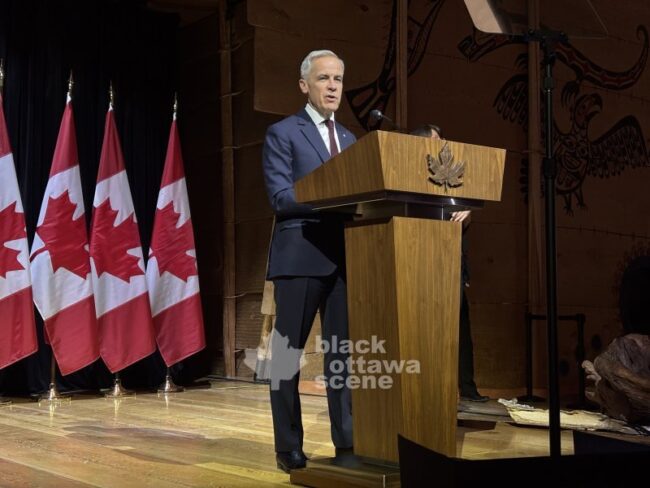
Prime Minister Mark Carney marked the 30th anniversary of Black History Month in Canada on Wednesday at the Canadian Museum of History, reflecting on the country’s complex history of racial inequality while highlighting achievements and ongoing challenges for Black Canadians. Speaking at a national gathering, Carney credited Hon Jean Augustine for first recognizing Black History Month in the House of Commons in 1995 and emphasized the importance of acknowledging both the struggles and accomplishments of Black Canadians.
“Black history in Canada is a story that must reckon with both the shadow and the light,” Carney said. He noted that slavery existed in New France and the Maritimes and that segregation continued long after its formal abolition. “The challenges of Black history are not chapters we can consign to another country’s past,” he said, highlighting discrimination in housing, schools, and public services that persisted “within living memory.”
Carney stressed that the commemoration is meant “to mark progress, not to declare victory,” pointing to continuing disparities. He cited statistics showing that nearly one in three Black Canadians struggles with food insecurity and defended federal programs such as childcare, dental care, and the national school food program as tools to address inequality. He also announced renewed funding for the Black Entrepreneurship Program, committing $190 million to improve access to capital and mentorship. “Canada’s promise is fairness,” he said. “Our economy is strongest when it supports everyone.” Carney celebrated trailblazers including Viola Desmond, Lincoln Alexander, and Rosemary Brown as examples of progress and resilience.
The event also honored Hon Jean Augustine, the first Black woman to serve in federal cabinet and a lifelong educator who introduced the motion establishing February as Black History Month in Canada. Augustine reminded attendees that the month is “not just routine remembrance” or “another calendar observance,” but a necessary affirmation that Canada’s national story must include the fullness of Canadian life.
“I came to this country 65 years ago as a young woman… with dreams and hopes for a better life,” Augustine said. She reflected on her journey as a teacher, emphasizing that classrooms play a critical role in shaping how a country tells its story. Introducing the motion in Parliament, she said it was “not for symbolism alone. Symbols matter. A country’s calendar is a statement of values.” Augustine concluded with a call to action: “Black history is Canadian history… not just for Black people,” and should be celebrated “365” days a year.
Honourable Marc Miller, Minister of Canadian Identity and Culture, also spoke at the event, acknowledging Black communities and Jean Augustine for establishing the national observance in 1996. “Thanks to the vision and leadership of Dr. Jean Augustine and the tireless advocacy of Black communities, Canada celebrated Black History Month for the very first time,” Miller said. He stressed that recognition is both symbolic and foundational, noting that progress was achieved because Black Canadians “fought tirelessly for justice” and pushed governments “to do better and to be better.”
Miller highlighted this year’s theme celebrating Black excellence across generations, emphasizing the importance of confronting anti-Black racism and ensuring institutions are “fair, inclusive and accountable.” Speaking personally, he referenced his representation of Montreal’s Little Burgundy neighbourhood and his role as the grandfather of a Black child. “I worry every day about how that beautiful boy will be treated today and in the future,” he said. “You matter. Your voices matter, and we are proud to celebrate your leadership not just in February, but every month of the year.”
Algonquin elder Claudette Commanda welcomed guests, honoring Augustine for her leadership and emphasizing that Black history is “not just for today but it is for every day.” Commanda called for unity between First Nations and Black communities: “Let us build this relationship…with one mind, one heart, one spirit, one voice, one prayer,” she said, concluding with a blessing for all attendees and their families.
The event drew a host of dignitaries, including Greg Fergus, the first Black Speaker of the House of Commons, Minister of Health Marjorie Michel, and Senator Rosemary Moodie, who chairs the Standing Committee on Social Affairs, Science and Technology. Highlights included cultural performances by the Sankofa cultural troupe and West-Can Folk Performing Company, which showcased storytelling, music, and dance rooted in ancestral traditions. The performances emphasized resilience, heritage, and the importance of honoring the past to inform the future.
With three decades of official recognition, Black History Month in Canada continues to serve as a reminder that the nation’s story is incomplete without acknowledging the achievements and challenges of its Black citizens.