Saturday 1 August 2026
CADHO hosts 2026 Emancipation Day: Demand Accountability, Take Responsibility
by Onoshe Nwabuikwu, Local Journalism Initiative reporter
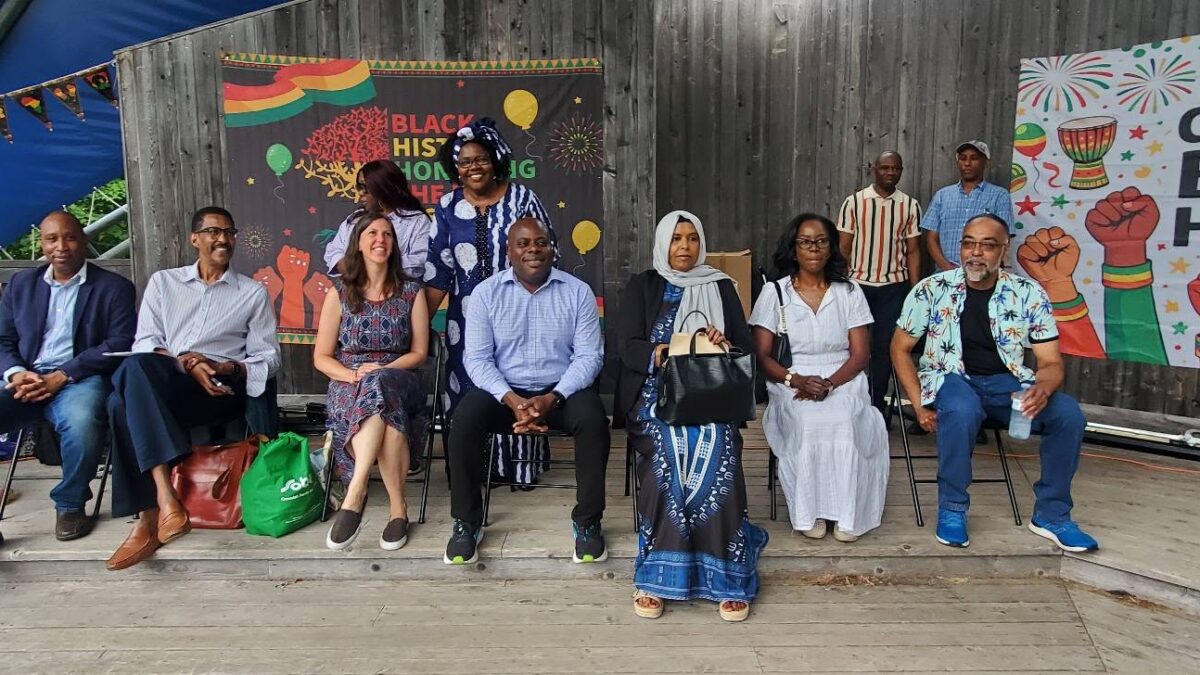
The occasion was the Emancipation Day event organised by CADHO (Canadians of African Descent Health Organisation) at the picturesque Andrew Haydon Park, Nepean, on Saturday, August 1, 2026, tagged “Celebrating Black Health and Well-Being: An Emancipation Day Event.” If any place typified a sense of wellbeing and freedom, it was Andrew Haydon Park, with its sprawling lush greenery and soothing body of water, which presented a near picture-perfect scene of man and nature, synchronised. This free one-day event has become an annual celebration since 2021, when Canada officially designated August 1 as Emancipation Day. That day is in commemoration of the August 1, 1834, abolition of slavery within the British Empire. The general objective of this event was to showcase the contributions of African, Caribbean and Black (ACB) communities and how embedded they are in Ottawa’s very fabric.
The event, which was handled by Sarah Onyango, who was the moderator, was properly kicked off by Dr. Josephine Etowa, CADHO’s president. She acknowledged the land and those who lived on it, especially those who welcomed ACB communities and ancestors. This year’s event, according to Dr. Etowa, is “especially meaningful because we are also recognizing Ottawa’s 200th anniversary of the founding of Bytown.” She stressed that Black people have been instrumental to Ottawa’s growth and their contributions must not be relegated to the background.
After this, it was a flurry of remarks to keep up with the schedule, as speaker after speaker came on to expand the day’s theme, which was all about celebrating Black health and wellbeing. Rawlson King, councillor for Ward 13, Rideau-Rockcliffe, opened the floor, so to speak. His remarks set the tone, and the sum of what he said was: “Our stories matter. Our wellbeing matters. Freedom is both a legacy and a responsibility. Emancipation is not just physical; it’s mental.” Dr. Awad Ibrahim, vice provost for Equity, Diversity and Inclusive Excellence (EDI) at uOttawa, led guests through important historical facts. From the arrival of Mathieu Da Costa, the first recorded free Black person to enter what’s now Canada in 1604, who came in as a translator of the Mi’kmaq. To 1796, when Blacks created their own school in New Brunswick.
The upshot of Dr. Awad’s remarks can be summed up in him telling ACB people to walk and stand proud because if “64% of us are born in Canada,” with Nova Scotia having generations that go as far as 3rd generations, with an incredibly young population up to two-thirds, all that’s left is to “Emancipate blackness. Celebrate this moment. Celebrate excellence,” and above all to, “hold each other accountable.” Echoing what had now become a refrain that Black people take charge of their health was Dr. John Ariyo, ED of Scarborough, who acknowledged his parents in the audience before giving his remarks. He reiterated the need to address health inequities and to remain self-conscious, saying: “We’ll never surrender because “none but ourselves can free our mind,” quoting Bob Marley’s Redemption Song. Ms. Susan Obiorah, CEO, SWCHC (Somerset Community Health Centre), livened the atmosphere as she came on stage dancing to the music from DJ Preachaman. Her advice was that Blacks must “move beyond treating illness” while pointing out that the most racialised community in Ottawa is the Black community.
Dr. Khaled Salam, ED, ACO (AIDS Committee of Ottawa), remarks harped on STIs like HIV, of which he said the Black population had most of the new infections from data collected two years ago. The challenge, he revealed, was not about treating HIV, which Canada has become very good at, but the fight against HIV/AIDS cannot be won through “biochemical interventions” alone. Certain systemic problems must be confronted, like issues around HIV stigma, homophobia, and anti-Black racism. Otherwise, HIV will continue to spread, he warned. However, Dr. Jude Mary Cenat, director VTRAC/ICBH, asked who we should hold responsible for these huge HIV numbers. The answer could be that there’s not enough diversity in medical studies, to name one possible factor. But then that raises another question that Dr. Cenat simplified into: “What can we do for ourselves?” What this means is that while it is okay to demand accountability from systems, the Black community, Black people must take responsibility because in the end, “together we are the solution,” Dr. Cenat affirmed.
Perhaps the best way to ensure Black people take responsibility was the suggestion by Hindia Mohamoud, EDI director, Ottawa Public Health (OPH), that each year, under CADHO, people should come together “to check for progress, compare notes, and to plan for the future,” so that things “go beyond talk.” Dr. Josephine Etowa had the last presentation, which focused on data from a study commissioned to develop a national ACB health data governance framework while decrying the absence of a national coordinated framework for Black data. The end goal, she concluded, was all “about changing who holds power over our data, how that power is used, and who benefits so that ACB communities move from being data sources to data stewards, decision‑makers, and beneficiaries.” This obviously reaffirmed Dr. Etowa’s opening charge that: “Nothing about us should be decided without us.” Other speakers were CEO of CHEO Dr. Vera Etches, who came after Dr. Awad, and Ms. Sophia Jacob, CEO, CWCLIN, who focused on thanking all the organizations that have helped her.
It was not all talk. The energetic and lively Stepstone Dance Group entertained guests. Also, Ida, who is part of CADHO, demonstrated and led guests through adaptive dance exercises. The day wrapped up with guests networking and enjoying some flavourful food.