Monday 31 August 2026
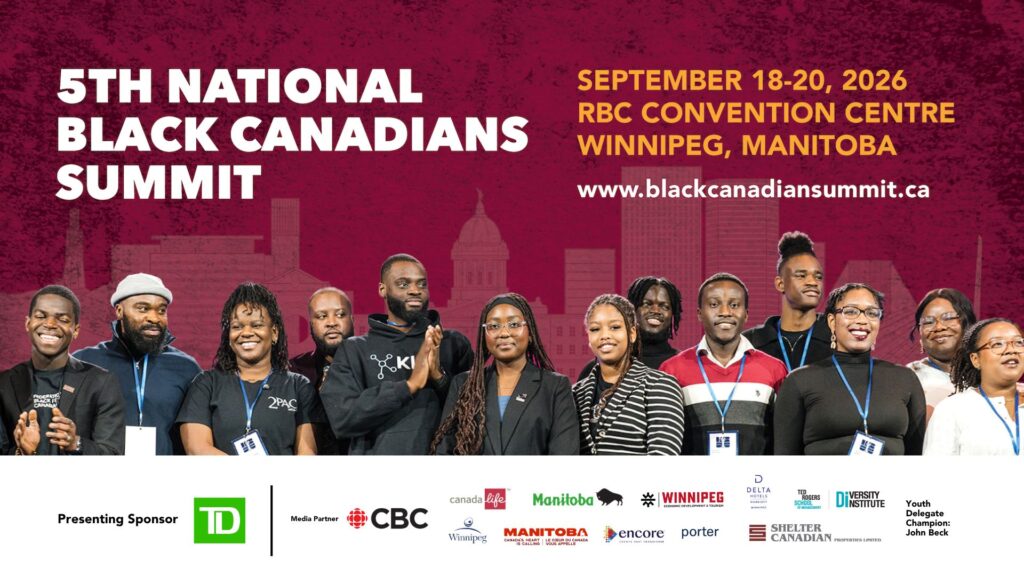
Launched in 2017 by the Michaëlle Jean Foundation, the National Black Canadians Summit positions itself as a national movement focused on community empowerment, systems change, and long-term impact. Through keynote conversations, workshops, performances, and networking opportunities, the summit aims to strengthen connections across sectors and regions while amplifying Black voices and lived experiences. The 5th edition of this gathering takes place in Winnipeg, Manitoba, from September 18 to 20, 2026. Black Ottawa Scene spoke with Edward Matwawana, Executive Director of the Michaëlle Jean Foundation, to find out more.
Black Ottawa Scene: Please tell us about your history with the Michaëlle Jean Foundation and why you joined the organization.
Edward Matwawana: I’m a community economic developer at heart, and an artist, a trainer and speaker. I joined the Michaëlle Jean Foundation because, from the outset, I found that there was an alignment between the mission, the mandate of the foundation and my own life and professional experiences. As a recording artist, I had also trained people in entrepreneurship both in Canada and overseas, and developed entrepreneurship programs for youth. I’m also an activist and a lover of social justice. So, when you put all that together, you see that I’m actually “at home” at the Michaëlle Jean Foundation. So, my work at the foundation is the epitome of my career. This is what drives me. Working at the Michaëlle Jean Foundation is not a job, but part of my mission.
Black Ottawa Scene: Please give us a brief overview of the Foundation’s initiatives and programs.
Edward Matwawana: The foundation works at the intersection of social justice, youth, arts and entrepreneurship. We work with youth from underserved communities to make sure that no one is left behind, and that there’s no isolation, and that people are included regardless of their situation. The Michaëlle Jean Foundation delivers all its youth programming under the umbrella “Power of Youth“. In there, you’ll find young people engaged in projects in their respective communities across the country. In fact, we started 3 years ago with 35 projects, and last year, we funded 25 projects from across the country. And these projects come to us from young people who are already leaders, who want to get better at what they do and respond to some of the issues in their communities, starting with addressing some of the issues which were addressed in the Halifax Declaration (https://fmjf.ca/en/initiatives/halifax-declaration/). The other program we have is the youth entrepreneurship program, which also trains young people in entrepreneurship from across the country. It’s a virtual program and we have a platform from which we deliver this training. And of course, we have the arts, which includes what we call the “fourth wall”. The fourth wall is basically making the invisible visible. We found that young people didn’t often have a voice, and this program gives them a voice while they use their art to express themselves. The youth-focused programming is rich at the Michaëlle Jean Foundation, and our job is to develop the new generation of leaders through all these initiatives. We believe the youth are not [leaders] for tomorrow, but for today. So, we need to give them space at the table so that they can be involved in accomplishing things in [their] communities, and our job is to mentor them to make sure that they are gaining the skills needed to become better leaders. Of course, one of the initiatives we’re involved with is the National Black Canadians’ Summit. This is an event that happens every two years in a different city in Canada.
Black Ottawa Scene: Tell us about the National Black Canadians’ Summit and highlight some of its key achievements since the first edition in 2017.
Edward Matwawana: This has gone from being an event to a movement because people follow it as it travels to different cities and provinces. The summit itself grew out of a call from emerging artists of African descent in Halifax, Toronto and Montreal who felt strongly that artists from across the country needed to unite to achieve better outcomes together. Since the first gathering in Toronto in 2017, followed by Ottawa in 2019 and a series of virtual events in 2021, the summit has grown into one of the country’s key platforms for reflection and co-creation among Black Canadians. Each call in the Halifax Declaration came out of the 2022 gathering built around the pillars of the U.N. International Decade for Peoples of African Descent: Recognition, Justice and Development. What sets this summit apart is that it is a gathering created by and for people of African descent bringing together leaders, youth, artists, researchers, performers, institutions, decision-makers through conferences and workshops, artistic presentations, community gatherings, side meetings, all in service of the same shared goals. The summit is a place where people go to learn, listen, share, connect, network, hear. So, this summit is called “National Black Canadians’ Summit”, but everyone is welcome. We welcome allies, people who want to support us in this fight to eliminate racial discrimination. So, all people are invited because we didn’t create this problem and we need everyone to be part of finding solutions. It’s not a “Black” problem, but a Canadian problem. Some of the key achievements of course, 2017 was an awakening. We had a declaration from the U.N. on the Decade for People of African Descent. Young people rose and decided that people needed to come together, and the foundation rose to the challenge. That took us to Ottawa in 2019. This was a very special summit because we ended up on the Hill. Young people went to [Parliament] Hill and spoke to decision-makers, some of whom heard for the first time what was happening in Black communities across the country. After that summit, we found that governments began to move, take action and pour resources into the Black community for a number of initiatives [in areas] such as entrepreneurship and health. So, there was a change in the momentum. Then, of course, COVID came, but we continued to gather. The virtual events we held during COVID informed what happened in Halifax in 2022. So, when we arrived in Halifax, we announced a declaration, the Halifax Declaration, a book that contains all the issues that affect Black communities in Canada in different sectors, whether it’s health, housing, business, sports, media, and so on. But this manifesto didn’t just come with issues but also provided solutions. The Halifax Declaration has become a reference for changing or arguing policy or creating new policies to benefit the Black community in Canada…and many other communities. In Montreal, which was the end of the first Decade for People of African Descent, we celebrated the Halifax Declaration because it had been announced in Halifax whereas in Montreal, it was a real product that we could use. Many of the sessions at the Montreal Summit in 2025 were based on the Halifax Declaration. And now we are moving to Winnipeg. The momentum continues. In fact, all the “youth” tickets were sold out so we added a few more tickets to allow more youth to attend. In fact, so far, we have over 600 youth registered. In Montreal, we had 1500, and we hope to get 1500 or more attend the Winnipeg summit.
Black Ottawa Scene: Please tell us about the theme chosen for the 2026 edition of NBCS, “Moving Forward Together”. What is its significance in the current polarized and anti-DEI mainstream context in which ACB communities are living?
Edward Matwawana: I think that with everything that’s happening, especially in the mainstream with anti-DEI and other rhetoric, I think it’s time we came together and moved together as a Black community. The summit is one of those moments that allows us to do that and then take things into the community. However, we also need to have solidarity with other racialized groups that are affected, like the Indigenous communities. Moving forward together because this is the type of work that one group alone cannot do. It should be a joint effort with other groups. That’s why we’re using that theme in Winnipeg, so that people hear all our voices, Black, Asian, Indigenous communities etc…All those people who feel marginalized. Winnipeg will be exciting because it’s also a city where many things happened, a lot of changes. The first time that women voted was in Winnipeg. It has the largest urban indigenous population.
Black Ottawa Scene:Who are you expecting at this year’s summit…and what should they expect in terms of programming, networking opportunities, summit outcomes, etc.?
Edward Matwawana: We have invited members of the Indigenous communities to join us and participate, to show them our solidarity and that we understand what they are going through as they understand what we are going through. Out of respect for where the summit is happening in Winnipeg, we are opening our doors to them to make sure they can be part of it. Besides the youth and artists, we’ll also have sitting senators from the African-Canadian Senators Group, federal officials, including from Canadian Heritage and the Treasury Board Equity Branch. There’s researchers and community leaders who all work on these issues day to day. We’ll have discussions and sessions, and it’s also multigenerational. We have youth discussing with more senior people, whether in age or career-wise, and real mentorship and teaching happens, connections are being made, people are networking and it becomes like one big “village”. And we’re putting out a call for non-Black allies to join us because it’s all our problem, and we need to come together to resolve this issue. Over the three days, the program includes, on the first day, Friday, the whole day is what we call “Power Youth Day”. The youth run the day, plan it, execute it. It’s for the youth, but everyone is invited. They choose their own topics and the panelists, and they run the day. That’s a very powerful moment not to be missed. In addition to that, over the three days, the program will cover specific issues like anti-Black racism, healthcare, modernizing the federal employment equity act, justice reform and community safety beyond policing, Black-led housing solutions, mental health care, anti-Blackness in AI, Black youth pathways into education, employment, entrepreneurship and much more. On Saturday the 19th, there will be seven sessions happening at the same time, so it becomes a “workshop village”. On Friday, at the youth day, we have an opening gala in the evening, which all delegates will attend. At this gala, there will be traditional performances, welcoming remarks, land acknowledgement, and Jully Black will be performing. Then Sunday morning will be the closing event which will pass the baton from Winnipeg to Calgary, where we plan to have the same summit in Calgary. On that last day, we’ll have a mass choir to close the summit, and a soloist: Measha Brueggergosman-Lee. So, this will be a rich weekend, so get tickets now as they’re going fast. We hope to welcome you in Winnipeg!
To register or get more information about the summit and the Michaëlle Jean Foundation, please visit https://www.blackcanadiansummit.ca