

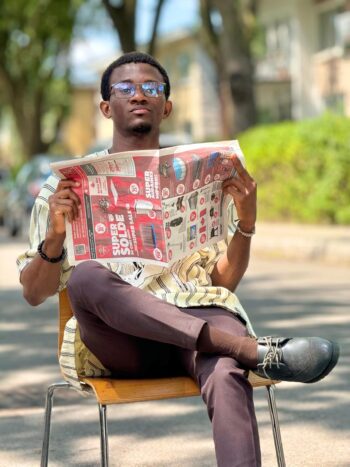
Some Stories Make the News. Others Are the News That Never Make the Headlines.
by Isiaka Kromah
Every day, we wake up and consume the news. We read about achievements, awards, promotions, victories, and breakthroughs. We celebrate the people whose names appear on our screens and whose stories are shared across communities. But behind every headline, there are thousands of stories that never receive one.
There are stories of people who kept going when quitting would have been easier. Stories of immigrants rebuilding their lives in unfamiliar places. Stories of young people carrying dreams bigger than their circumstances. Stories of parents making sacrifices that their children may never fully understand. These stories may never appear on the front page, but they are often the foundation of the stories that do.
As a boy who grew up in Liberia and as someone navigating life as a young African immigrant in Canada, I have learned that recognition usually comes after the struggle, not during it. The world often celebrates the outcome but rarely witnesses the process, the late-night reading, and the brainstorming. People see the success, but they do not always see the uncertainty, the sacrifices, the difficult decisions, and the moments when belief was the only thing keeping someone moving forward. Being born and raised in a post-war nation, I know what it means to believe and hope when hope is never in sight.
Our current society has created a culture where we often celebrate people after they become visible, but we sometimes forget the invisible battles that created their visibility. For many members of the Black community, these unseen stories are everywhere.
They are found in the student who leaves home to pursue an education and carries the pressure of representing an entire family. They are found in the entrepreneur who builds something from nothing while facing doubt and limited resources. They are found in the newcomer who arrives in Canada with a dream but must first overcome the challenges of starting over. They are found in parents doing two jobs or two shifts just to give their children a life here.
These are not ordinary stories. They are stories of courage. Yet many of them remain untold. Many of them never make the news. We never get to hear about them.
As a writer, spoken-word artist, and community advocate, I have always believed that storytelling is more than entertainment. Stories are how communities preserve their experiences, challenge assumptions, and remind people that behind every person is a journey that deserves to be understood.
We often ask people to celebrate success, but perhaps we should also learn to celebrate the process. The journey matters. The small victories matter. The moments when someone chooses to hope despite disappointment matter. The courage to continue matters.
Especially within Black communities here in the diaspora, where many individuals have had to overcome barriers that are not always visible from the outside, telling these stories is important. Representation is not only about seeing successful people on stages or in headlines. Representation is also about recognizing the paths that brought them there.
A young person needs to know that their current chapter does not define their entire story. An immigrant needs to know that starting again is not starting from nothing. A person working quietly toward a dream needs to know that progress does not become meaningful only when it receives public attention.
Growing up in Monrovia after the 14 years of civil unrest, every time you turned on the news, it was more about the killings, the war, and the devastating moments people experienced. But what failed to make these headlines were the striving mothers selling on the streets of Monrovia to put food on the table for their families, hardworking fathers leaving home under the sound of gunfire to make ends meet for their families, and young boys and girls striving to be themselves while trying to adapt to an environment no one was supposed to survive in.
These were the real stories of courage, hope, perseverance, and the zest to live and survive in a place and at a time when tomorrow was never promised. If something is to make the news, if anything is supposed to be news, these stories of survival, courage, and hope should be.
Some stories make the news. But some stories are the news. They are the stories of resilience, determination, sacrifice, and hope that happen every day around us. They may not always receive a headline, but they are shaping families, communities, and future generations.
Maybe the question we should ask is not only: Who is making the headlines?
Maybe we should also ask: Whose story deserves to be heard before the world finally notices? Because sometimes the most important stories are not the ones everyone is watching.
They are the ones that quietly create the future.
Isiaka A. Kromah is a Liberian writer, spoken-word artist, author, and community advocate based in Montreal, Quebec. Through storytelling, mental health advocacy, and social conversations, he explores themes of identity, resilience, education, leadership, and the experiences that shape African communities around the world.
Sometimes the most important story isn’t the one people are watching, but the one that didn’t make it to the headlines or news.
Thanks for such a masterpiece,Isiaka A. Kromah
Great article
Keep it up bro
This is a mastered piece. Short, easy to understand and one to build on again for courage and determination. Kudos to you, Isiaka.